Monday, June 29, 2026 ● AASSM Main Hall ● 9:00 PM
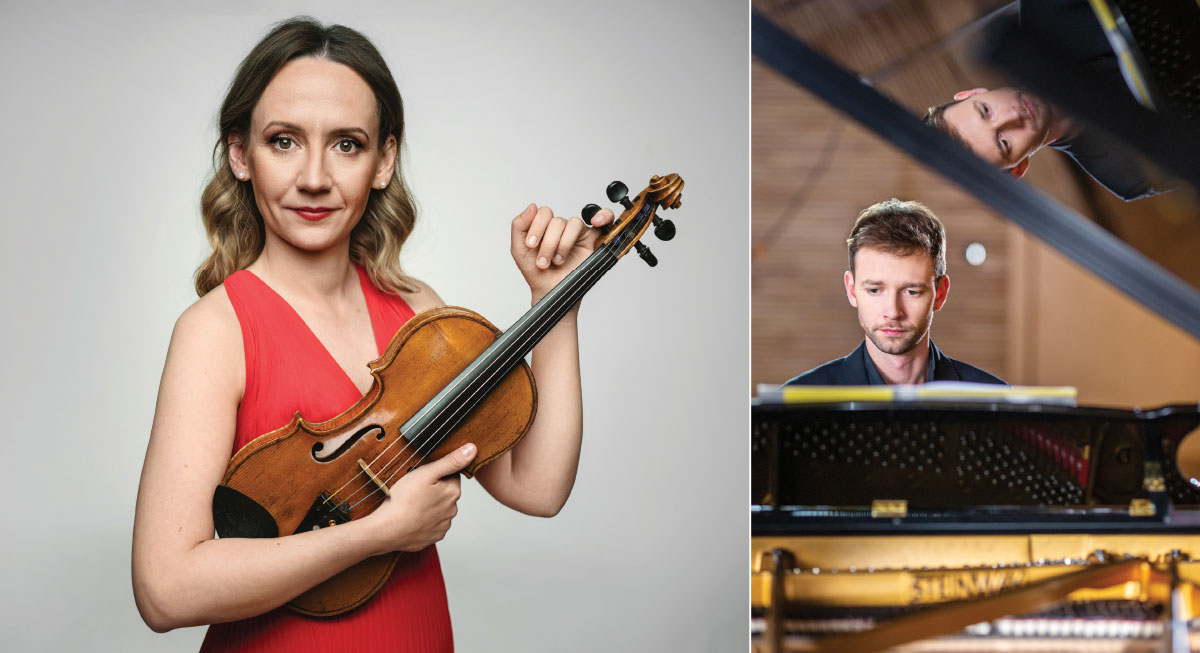
AGATA SZYMCZEWSKA & WOJCIECH SZYMCZEWSKI
CLASSICS FROM POLAND
Agata Szymczewska, keman
Wojciech Szymczewski, piyano
Program
H. Wieniawski – Polonez D-dur Op 4
I J. Paderewski – Melodia G –dur (arr: S.Barcewicz)
G. Bacewicz – Oberek nr 1
F. Chopin – Mazurek a-moll Op 64 nr 4
H. Wieniawski – Dudziarz Op 19
K. Szymanowski –“Źròdło Aretuzy” Op 30
W. Lutosławski – Lullaby for Anne-Sophie
H. Wieniawski – Legenda Op 17
K. Szymanowski –Kołysanka Op 52
E. Młynarski – Mazur G-dur
G. Bacewicz – Melodia
G. Bacewicz – Kołysanka
H. Wieniawski – Obertas Op 19
AGATA SZYMCZEWSKA, violin
She belongs to a select group of the most outstanding Polish violinists recognized internationally.
“She plays with a seriousness, composure, and musical wisdom beyond her years, sounding at times like a fiery young Ida Haendel.” The Times, London
Since winning First Prize, the Gold Medal, and the Audience Prize at the 13th International Henryk Wieniawski Violin Competition in Poznań, she has performed numerous times in many famous concert halls, – including New York’s Carnegie Hall, Chicago Symphony Hall, the Kennedy Center in Washington, the Wigmore Hall in London, the Théatre des Champs-Élysées in Paris, the Concertgebouw in Amsterdam, the Palau de la Musica in Barcelona, and the Berlin Philharmonic.
She has given concerts under the baton of the most outstanding conductors, including S. Ozawa, Sir N. Marriner, R. Muti, A. Boreyko, M. Vengerov, K. Penderecki, J. Axelrod, J. Maksymiuk, J. Kasprzyk, K. Urbański, M. Nesterowicz, A. Wit, J. Krenz, and at the Royal Festival Hall with the London Philharmonic Orchestra conducted by O. Vanska.
Chamber music is also an important part of Agata’s career, and she has performed with many outstanding musicians, such as K. Zimerman, M. Argerich, I. Levit, A. Mutter, G. Kremer, M. Vengerov, M. Maisky and Y. Bashmet.
Since 2014, Agata Szymczewska has been leading violinist of the renowned Karol Szymanowski Quartet, and since 2021, she has also performed with jazz musicians, including the renowned Adam Bałdych. A recipient of the 2009 London Music Masters Award, the Polityka Passport Award, the TVP Kultura Award (in the Classical Music category), and four Fryderyk Awards, her recording career includes over a dozen CDs and DVDs released by Deutsche Grammophon, Sony Music, Universal Music, and many others.
Szymczewska graduated from the Hochschule für Musik und Theater in Hanover studying under Prof. Krzysztof Węgrzyn and from the Academy of Music in Poznań in Prof. Bartosz Bryła’s class. She is currently a professor of violin at the Fryderyk Chopin University of Music in Warsaw. In June 2023, she was elected as President of the Henryk Wieniawski Music Society in Poznań.
Agata plays a Nicolo Gagliano violin (1755) provided courtesy of Anne-Sophie Mutter.
WOJCIECH SZYMCZEWSKI, piano
Wojciech Szymczewski perfected his piano playing skills by participating in master classes led by outstanding piano teachers. In the years 2008 to 2018 he co-founded a piano duo with Bartosz Kołaczkowski, celebrating their success in 2014 by winning 1st prize at the 12th Padova International Competition in Italy, and 1st prize at the Bradshaw & Buono International Piano Competition 2015 in New York.
In December 2014, the duo made a concert tour of Italy (Padua, Abano, Venice), and in 2015 they debuted at New York’s Carnegie Hall on May 17th. Wojciech Szymczewski has also been performing with his violinist sister, Agata Szymczewska, for several years. They have performed at such venues as the Royal Castle in Warsaw, the Krakow Opera, festivals in Łańcut and Nałęczów, and the UNICEF “Polish Artists for Syria” Gala.
In 2022, they jointly implemented the Polish Music Publishing House project “Music from Chopin’s Country,” recording 30 Polish miniatures for violin and piano. They have also performed abroad, promoting Polish music in Cremona, London, Cardiff, and Nicosia.
In 2015, Wojciech Szymczewski began working at the St. Moniuszko Academy of Music in Gdańsk, and is also currently a piano teacher and chamber pianist for the Music School Complex in Gdańsk-Wrzeszcz. He has received dozens of distinctions and diplomas for his piano performances at numerous competitions and festivals both in Poland and abroad.
Program Bilgileri
Henryk Wieniawski – Polonez D-dur Op 4
Drafted when Henryk Wieniawski was only 13, this work is a testament to his early genius and devotion to Polish national identity. Musically, it bridges the brilliant virtuosity of the Franco-Belgian violin school with the noble stature of the Polonaise, Poland’s aristocratic court dance. The piece demands supreme technical mastery, featuring intricate double-stops and expansive chords.
Ignacy Jan Paderewski – Melodia G –dur (arr: S.Barcewicz)
Originally part of Ignacy Jan Paderewski’s “Chants du voyageur” for piano, this work was transcribed for violin by the celebrated Stanisław Barcewicz. The piece reflects a melancholic yet hopeful atmosphere often associated with Paderewski’s patriotic soul. The melody unfolds as a profound inner monologue, showcasing the violin’s singing quality through an expansive lyrical form.
Grażyna Bacewicz – Oberek No. 1
Grażyna Bacewicz, one of the most prominent composer-violinists of the 20th century, reimagines the Oberek—the fastest of Polish folk dances—through a neoclassical lens. Composed in 1949, the work blends folkloric vitality with sophisticated harmony. Her intimate knowledge of the violin is evident in the dizzying speed and the sharp, percussive precision of the rhythmic accents.
Frédéric Chopin – Mazurek a-moll Op 64 nr 4
Originally a posthumous piano work, this Mazurka embodies “Żal”—the quintessential Polish spirit of longing and sorrow. Through transcriptions by legendary violinists, the piece gains a new dimension; the violin’s bow allows for a breathing, vocal-like melancholy that transcends the percussive nature of the piano.
Henryk Wieniawski – Dudziarz, Op. 19 No. 2
The second of Wieniawski’s “Deux Mazurkas Caractéristiques,” this piece is a vivid example of 19th-century program music. By using double-stops and drone-like open strings, the composer imitates the “duda” (Polish bagpipe), transporting the listener to a village square celebration. It is both a character study and a brilliant display of bowing technique.
Karol Szymanowski – “Źródło Aretuzy”, Op. 30 No. 1
The opening movement of the “Mythes” cycle, this masterpiece revolutionized violin writing. Karol Szymanowski employs innovative harmonics and shimmering tremolos to depict the ancient myth of a nymph’s aquatic transformation. It is a mystical narrative woven with an impressionistic color palette that transcends time and space.
Witold Lutosławski –Lullaby for Anne-Sophie
This elegant late-period miniature was composed in 1989 for Anne-Sophie Mutter. Departing from traditional lullabies, Lutosławski creates a restless serenity and a nocturnal mystery. Its transparent texture, reminiscent of his “controlled aleatoricism,” allows the violin’s most delicate timbres to shine with crystalline clarity.
Henryk Wieniawski – Legend, Op. 17
The “Légende” is rooted in one of music history’s most romantic anecdotes, composed by Henryk Wieniawski to win over his future father-in-law. Starting with a haunting G-minor narrative, the piece unfolds like an epic tale told by a wandering bard, reaching a passionate peak that secures its place as a cornerstone of Romantic violin literature
Karol Szymanowski –Kołysanka, Op. 52
A product of Karol Szymanowski’s mature period, this “Kołysanka” is a mystical, hypnotic journey on the edge of tonality. Floating over a persistent ostinato, the violin moves away from the traditional nursery tune, evoking a voyage into the depths of the human psyche and the realm of dreams.
Emil Młynarski – Mazur G-dur
Emil Młynarski, a pivotal figure in Polish musical life, fuses aristocratic elegance with folk energy in this “Mazur.” Representing the “style brillant” of the Polish violin school, the work is noted for its rhythmic elasticity and the exuberant expressive power it demands from the soloist.
Grażyna Bacewicz – Melodia and Kołysanka,
These two miniatures reveal the human warmth and clarity within Grażyna Bacewicz’s neoclassical language. While “Melodia” offers a fluid and sincere cantilena, the “Kołysanka” (Lullaby) dissolves modern 20th-century harmonies into a tender atmosphere, showcasing the perfect balance between formal discipline and emotional intensity.
Henryk Wieniawski – Obertas, Op. 19 No. 1
The program concludes with the Obertas, one of Poland’s most dynamic folk dances. Henryk Wieniawski treats the violin as a virtuosic folk instrument at a village wedding. With its dizzying speed, sudden dynamic shifts, and joyous character, it brings the concert to a triumphant close, celebrating the spirit of the Polish violin tradition.